Technical Note
Details
PID Control and Regulation
ALTEC controllers measure and control process variables such as temperature, humidity, pressure and flow. The examples use temperature because it is common in industrial equipment, but the same principle applies to other analog variables.
Closed-Loop Control
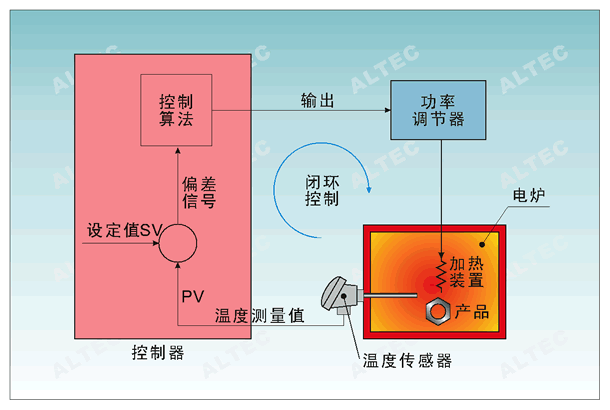
A closed-loop system compares the measured process value (PV) with the target setting value (SV). The controller adjusts output power to reduce the error between PV and SV until the process reaches the required value.
Sensors
Automatic controllers first need a reliable measurement. ALTEC controllers accept many sensor inputs, including thermocouples, resistance temperature detectors, strain, pressure, flow and pH signals. For large systems, signal conditioners are often used to convert sensor measurements to 4-20mA or 0-10Vdc before entering the controller.
Control Outputs
Controllers use outputs to regulate heating power, flow, pressure or other process values. Common outputs include relays for contactors and valves, logic outputs for solid-state relays, SCR zero-cross outputs for higher-power loads, and DC current or voltage outputs for valve positioners, phase-angle power modules or variable-frequency drives.
ON/OFF Control
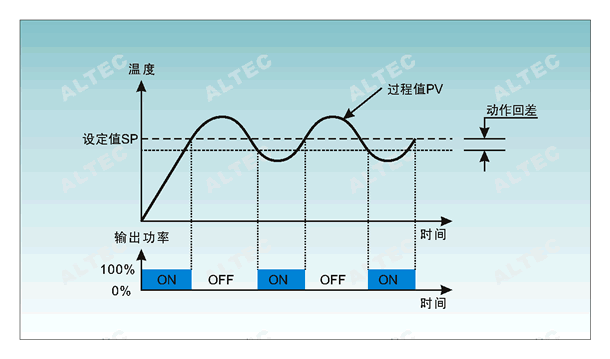
ON/OFF control switches full output on below the setpoint and switches output off above the setpoint. The process value oscillates around the setpoint, so this method is best for applications where high precision is not required. A hysteresis value prevents relay chatter near the setpoint.
PID Control
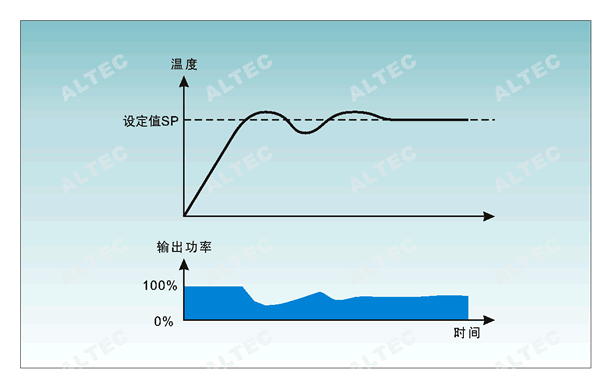
Most industrial heating processes require stable control instead of wide oscillation. PID combines proportional, integral and derivative actions. The output is based on the size of the error, how long the error persists and how quickly the process value is changing.
Ramp and Soak Program Control
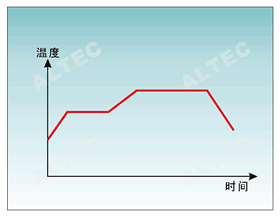
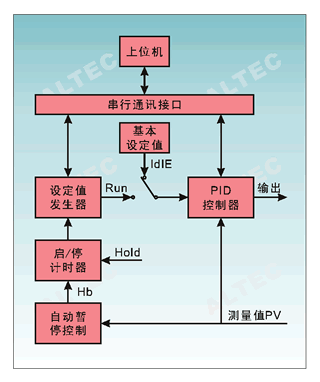
When an ALTEC controller is used as a program controller, the instrument contains a setpoint generator and a PID controller. The generator changes SV according to the configured curve, while PID control makes PV follow that curve.
Time-Proportioning Output
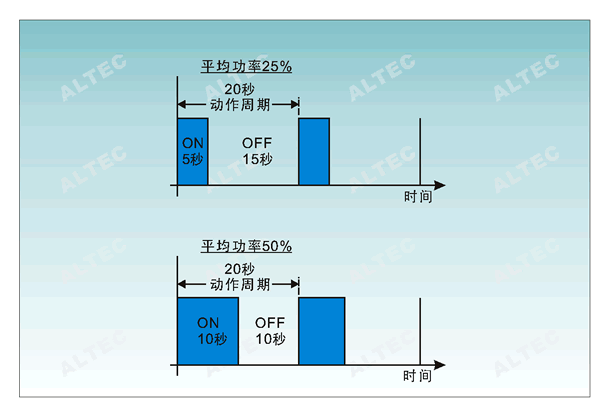
For high-accuracy temperature control, a PID controller needs to vary output power smoothly from 0 to 100%. Time-proportioning output changes the on-time ratio of relay, SCR or solid-state relay outputs to obtain variable power. Shorter cycles deliver smoother heating, but mechanical relay life must be considered.
Motorized Valve Control
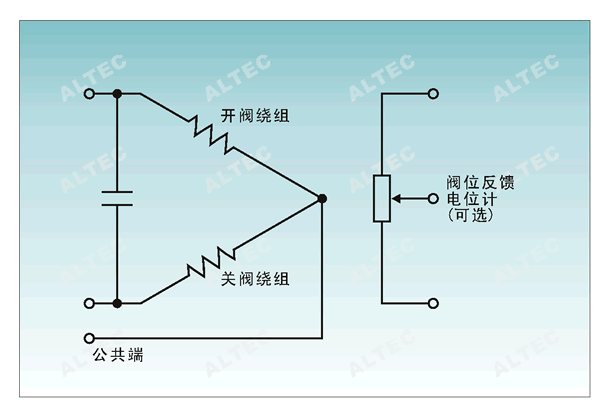
A motorized valve normally has one winding for opening and one for closing. Valve position is controlled by adjusting open and close time. ALTEC controllers include algorithms designed for motorized valve position control.